Showing posts with label snow. Show all posts

Friday, February 12, 2021

Snow days


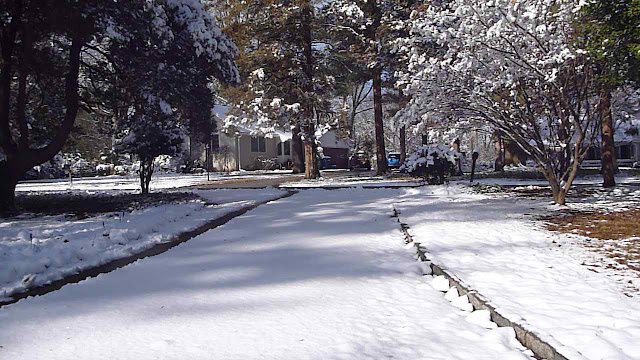
It's been a snowy February in my mid-Atlantic region, where just three weeks ago long-range forecasters were predicting a winter of very little snow: "Sorry skiers!" they were saying.

But now there are several inches of snow on the ground with more to come. And once there's snow on a huge tract of land, reflecting the sun's heat back into space, what will happen next is anyone's guess.

While walking to the end of my driveway to get the morning newspaper yesterday, my head was down as a measure of extra care to try to prevent a fall. I was thinking about how when I was young looking at a newly fallen field of snow made me think about how lovely a sight it was. That virgin white. Now, in my early sixties, all it made me think of was how many floaters I have in my aging eyes. Will I ever need cataract surgery, or will death find me first?

* Photo note. The photo is of a woman named Katherine, who lived in the same apartment building as I did in Philadelphia. It was taken during a major storm in the aughts. She was a neat young woman who had just become a school teacher. I didn't know her very well, and like many in my small apartment building (a six-unit converted rowhouse) she moved into a better place after a few months, unlike me, a loser, who lived there for twenty years. When I first saw her shoveling I thought it was a kid helping out a mom or dad, she looked so small, but although Katherine was not very tall, she was no kid.


Monday, February 19, 2018

My imagined future

I get the leg amputated a week from today. I cope with the pain and put a brave face on things. Though I'm adept on crutches, I'm far less mobile than before. Even strong arms are not designed to bear that much weight, and I'll be sixty in a few months. The wear and tear will take their toll. Meanwhile, every three months I'll go in for a chest scan with contrast, which means I'm injected with a dye to see whether or not the disease has spread to my lungs, which it will have a seventy-five percent chance of doing despite the amputation, and will kill me in a year or so. When the results show nothing, I'm as happy as I can be under the circumstances. But not for long; the three months between scans pass quickly. If nothing shows up after two years of this, the rate of scanning goes to twice a year. That's an improvement, but still, for the rest of my years my concept of "the future" is a truncated one. 
https://youtu.be/LrsmOfyI7vohttps://youtu.be/LrsmOfyI7vo

If I survive those years, mobility becomes an increasing problem. I can drive, but once I'm at a destination most other things become hard enough that my motivation to do much lessens. Going out to dine in a restaurant or see a movie in a theater is no longer worth the trouble and honestly, how much have I ever really gotten out of viewing paintings in museums? I still go to family events and my closest friends visit me but over time my world shrinks to my immediate surroundings. I savor the view of the backyard from the porch and enjoy watching dog-walkers and runners through the kitchen windows. When I'm sixty-five, I'm living like someone twenty years older than that.
At times I look at the videos I made in the last weeks before the amputation and the photographs I printed out. I made them knowing that it would fascinate and depress me to see them in the years ahead.

Saturday, December 30, 2017

Types of snow

Most know that lake effect snow is when moisture from a lake is picked up and then falls inland in the form of snow, as was the case recently in Erie, Pennsylvania, which saw five feet of snow from one weather event as a result.
driveway cleared of snow
Part of my driveway, cleared of snow.

It seems that where I live there should be something called suburban effect snow because no matter how much the forecasters in Philadelphia—just twenty miles to my east—say will fall in this region, the reality in my suburb is significantly more. Today, they called for two inches. I got around five.
Usually, snow in this area is followed by warm days so with snow like that I'd do a minimal amount of shoveling. Not this time. It's going to remain cold for several days longer and get colder than it is right now, which is 22 degrees.
Not that I'm complaining. I shoveled. All of it. Edge to edge. I followed that by sweeping. It took about two hours because I did it slowly. The distraction of using my body was a welcome one, especially knowing that in a couple of months, after I've had my right leg amputated near the hip, I will never shovel snow again.
Of course, even with the leg gone, it's probable that I'll never see snow again either thanks to the sarcoma I have growing in my lung which, if not removable (I'll find out January fourth), will kill me pretty fast.

Thursday, November 5, 2015

The winter of 2013–2014, west of Philadelphia


man bicycling in snow philadelphia
A man rides his bike after a snowstorm in Philadelphia, Pa.
People have tried to foretell the weather for millennia. They’ve read tea leaves, observed animals, consulted aching joints, and fired up supercomputers. The results have always been about as good as flipping a coin.
In October of 2013, AccuWeather, the private forecasting firm, predicted that people in the eastern United States would enjoy a mild 2013–2014 winter and would probably have to wait until February to see a substantial amount of snow. They also said California would get enough precipitation to make its drought worries a thing of the past.
Hardly. The West Coast drought would continue unabated and the northeast would endure a season deemed the most disruptive in 130 years.
On December 8, with the winter solstice still nearly two weeks away, the nation watched the hosting Philadelphia Eagles defeat the Detroit Lions 34–20 during a blinding snowstorm that covered the field with eight inches of snow by game’s end as 70,000 football fans shivered in the stadium. The amount was more than in all of the previous winter and twice that of 2010–2011. It was the first of four snowfalls of eight inches or more the season would see in a city that had never recorded more than three storms of six inches or more in one season.
Winter arrived, the storms and cold continued, and Americans began hearing a phrase new to most of them: polar vortex. The phrase refers to the conditions in the Arctic that usually keep most of the extremely cold air there. With the Arctic warming twice as fast as the rest of the planet, however, its ice and snow cover has diminished. That, scientists theorize, has weakened the polar vortex, letting freezing air masses escape and head south, leading to a greater number of extreme weather events in the Northern Hemisphere’s mid-latitudes. Europe’s bitter winters of previous years made them aware of the phenomenon before Americans.
The cold air masses helped generate the season’s heavy snows. Fifteen inches fell January 21, followed by severely cold temperatures rivaling the lowest of the season, which was 4 degrees on January 7. Interspersed among the large storms that winter were numerous “nuisance storms” featuring snowfalls of a few inches, enough to slow down daily life and make cautious school administrators cancel school. The weather in December and January slowed businesses too, but it was nothing Philadelphia’s western suburbs hadn’t seen before.
Then came February 5.
On the afternoon of the third, the National Weather Service had issued a winter storm watch for several counties in eastern Pennsylvania and New Jersey. Less than twelve hours later, the watch was upgraded to a warning to counties in Maryland, Delaware, New Jersey and Pennsylvania. The service tracked an area of low pressure from the Tennessee Valley on February 4 and said it would arrive in this region the next day. Meanwhile, a cold air mass from the north had settled over the surface of the Interstate 95 corridor. With the warmer air mass moving in above it, an icing event of some magnitude was predicted to hit at least a portion of the area.
Some schools and business closed in advance of the storm, but it turned out not to be widespread, and most of the warnings and advisories were cancelled. Most, but not all. The mid-thirties temperatures meant that instead of snow, the areas north and west of Philadelphia and Trenton got rain. That rain fell on snow from a recent storm still on roadways and tree branches. It froze as it landed. It was an ice storm, and a big one.
hanger outside after ice storm
A hanger left outside during an ice storm shows the effects.

From late in the morning throughout the afternoon, that Wednesday’s silence was punctured by the dull, thick crack of branches and trees succumbing to the weight of ice as thick as half an inch. Many of those branches and trees fell on power lines already burdened with ice, lines that, unlike those in most advanced nations, have not been buried underground due to the excessive costs cited by power companies. (Since the late-sixties, developments in America feature underground power lines thanks to policies initiated under the Johnson Administration.) The ice caused a high number of trips to emergency rooms thanks to slip and falls and car accidents, shortages of rock salt, school and business closings, and mass transit delays and cancellations. But it was the falling trees that had the most dramatic effect.
In addition to damaging houses and cars, they knocked out power for over 822,000, more than the nearly 640,000 in the 1993–1994 season, and nearly as many as the 850,000 customers who lost power during Superstorm Sandy in October of 2012. For as long as a week, many residents in Philadelphia's western suburbs lived like their 19th-century ancestors, reading by candlelight and warming their houses by burning wood. The romance of that wore off soon, however, as houses chilled and freezing pipes became a concern. Line workers came from far away states to rewire neighborhoods. The buzz of chainsaws and wood chippers went on day and night. PECO’s phone line infuriated thousands as the energy company taunted them with a recorded message that unfailingly vowed that power would be restored by 11 p.m. the day of the call for the duration of the outage, an issue PECO later promised to address. Some homeowners fled to the guest rooms of friends or to hotels. Others stayed put, fearing that opportunistic burglars would rob their darkened houses. Gas-powered generators chugged through the days and nights of some homeowners, keeping the lights and the furnace on, but at the high cost that comes with burning eight to twenty gallons of gas a day.
The power came back in pieces, dividing neighborhoods. On one side of a street, a family with power cooked large meals in brightly lit kitchens, took hot showers, watched television and snuggled under electric blankets in warm rooms. On the other side of the same street, a family without power bumped around in the dark, ate out, and went to bed early and unwashed under piles of cold blankets and bedspreads. Television and internet service often took longer to come back as their providers dealt with their own scheduling problems.
The impact of the eleven days of storms lasted beyond the season. Arborists serviced private clients at least well into the following fall. Gardens needed replanting, lawns reseeding. Beloved shrubs had been murdered by the cold, reinforcing the idea that autumn is the wrong time to prune. The roads were in terrible condition thanks to the 157,000 tons of salt they’d been subjected to (PennDot officials said reserves had been pushed to a crisis-low level) and the later freeze-thaw conditions that produce pot holes. It took almost 16,000 tons of patching material to get the state’s roads back in shape, twice the amount used in the two previous years combined.
The implacable winter left, but it took its time doing so. On March 27, Philadelphia reported a low of 23 degrees. As late as April 16, the city had a sub-freezing low. But as always, spring arrived, with its usual April showers and May flowers. April 30 was the wettest day of the year with a torrential 4.5 inches. Summer and fall were unremarkable.
In early February of 2015, as area residents watched temperatures dip into single digits during a season that would again be severe, albeit without the crippling storms of the winter before, the Geneva-based World Meteorological Organization released its findings for the previous year. Globally, 2014 was, by less than one degree, the hottest year ever in a historical record dating from 1880. The finding echoed that of an announcement released in January by two American scientific agencies and one in Japan. Although those on the East Coast know their chosen region makes up only a fraction of the world’s total land mass, few would blame them for believing that the planet’s thermostat was set low, not high, just as those who had broiled in other lands might have doubted accounts of strong trees felled by ice. As with any extreme event, you had to be there.

Wednesday, January 28, 2015

The blizzard of '15

The friendly supermarket cashier asked the Complete and Total Loser whether he was stocking up for the anticipated severe weather due to hit that night.
"Nah," the Loser said. "It's only going to be a few inches."
"Oh!" said the cashier. "You're so optimistic!" 
The Loser shrugged and smiled.
woman ice winter snow
About three inches fell. 
The Loser's area newspaper ran a photo of some girls sledding on what was mostly grass to go with their story about how the storm was nothing like it was predicted to be. 
This often happens to the Loser when it comes to the weather. He looks at a weather map with care, and just knows. 
So why is it that he can do this yet he never has an idea—even now that he's in his mid 50s—of what to say to a woman?

Tuesday, March 12, 2013

No Winter

Although much of the U.S. received heavy snow the past three months, the eastern third of the Complete and Total Loser's mid-Atlantic state never got more than a dusting, enough to panic elderly shoppers and get out the salt trucks, but never more than a wet-shoe nuisance.
That makes two seasons in a row of hard ground or mud. 
This should be all right with the Loser. He is, after all, getting old, and with his bad leg he falls easily and hard on slick surfaces. But the Loser misses that one annual blizzard that shuts everything down and excuses him from work, gives him free exercise shoveling, and lets him stay indoors alone without his lack of friends being the reason. A good book, a hot drink, black skies and blue shadows on the ground. The Loser misses the way gravity uses snow to paint and sculpt, reshaping the landscape, kabuki makeup over blemished roads and brown lawns.
Snow gives the Loser a respite from daily life.
By the end of this century snow will be rare, maybe even in places like this. But by the middle of this century the Complete and Total Loser will have been dead and forgotten for years.

Friday, February 15, 2013

That Time of Year

Actually, it's usually early March when the Complete and Total Loser's East Coast city has that crazy weather range in which you have snow like this at 7:30 in the morning:
And then see a girl on the train platform less than twelve hours later dressed in shorts and a short-sleeved shirt, making the Loser feel like an overdressed crazy man in his heavy coat and hat.

Yes, it's usually in-like-a-lion-out-like-a-lamb March when you have this duality. But it seems the seasons have shifted by a month or so in the Loser's lifetime, so maybe what was March is February now.

Thursday, December 24, 2009

Physical Pain

The Complete and Total Loser, being a loser, fell hard on his gimp leg today while walking on hard-packed snow and is in extreme pain as he writes this.
The Loser has fallen before. Always the same way: left foot goes shooting out from under him, body goes down on bum right leg, which bends and twists ways it shouldn't. Much soft tissue damage followed by swearing, then swelling. For some days the Loser will walk like an amputee with a new prosthesis.
snow covered grill
Snow-covered grill.

Ah, pain. The Loser has met women who enjoy being spanked. Not by him, of course; he is a loser with women as he is in all aspects of life. The desired puzzled him at first. Then once, while alone (this was years ago), he spanked his own buttock cheek. It felt refreshing. Invigorating. It's not something he pursued in any way, but if he ever did become half of a couple and she wanted to be spanked, he'd understand.
The kind of pain he feels at the moment is not that kind. It's a sharp ache, not a bright slap. The Loser has had worse pain. At 12, he had an operation which surgically broke large leg bones ten times to slow the growth of his "good" leg. This was in the late 1960s and doctors feared getting kids hooked on painkillers, so they were stingy with relief. The Loser howled in pain off and on for two weeks, while blood seeped through his thick body cast.
Odd, how you can think when in some kinds of pain but not others. If the pain the Loser feels now were in his head, he'd be writing this. If it were in his stomach, he'd be curled into a ball, whimpering.

Wednesday, February 4, 2009

It Snowed on the Loser


The Complete and Total Loser approves of snow for a time. He likes the way it covers ugliness, transforms landscapes, reflects light in new ways, muffles sound.
storm drainBut as the Loser never reached the level of success most his age reached years ago he lives in his city in humble circumstances, where snow soon becomes a nuisance, making biking or walking through it in both its thawed and slushy states treacherous on his aging, deformed limbs. Clumsy, top heavy and unbalanced, when he slips and falls he falls hard. During an ice storm some years ago, he fractured a joint, requiring a splint and crutches for six long weeks. The soft tissue damage caused such excruciating pain he laughed in disbelief.
At various times during the Loser's life, snow has meant different things. Days free from school, temporary employment, enforced time with family despite his fantasies of enforced time with pretty girls.
Despite the difficulties it causes him now and is bound to cause him in the future, the Loser has no plans to ever move to a warmer climate. Snow will always speak to the boy in him, the boy who would go on long walks in heavy snow across fields into sparse woods toward places he'd never been until his feet were wet and cold. Head down, the white, glittering surface were all he could see, the sound of the crunch under his feet all he could hear. Each step was a newly done thing requiring concentration beyond that needed for other activities. The walks soothed him and are still an important memory.